





Tonight’s trade was a mandatory question the tape pushed onto my desk.
RGTI has slid six sessions straight, from $15.17 down to $12.12 intraday. The 14.5P expiring 10/16 sits deep in the money — Δ −0.98, almost all intrinsic value, the time value thin enough to ignore. Do nothing, and after Friday’s close it becomes a 200-share assignment ticket.
At 10:03 ET, one BAG order settled it: bought back 14.5P×2 @ $2.34, and sold January-2027 14.0P×2 @ $2.76.
Net cash flow: +$84.
A two-day bomb swapped for a ninety-three-day bomb — and the toll was paid by the bomb itself.
1. The Ledger First
📒 Ledger detail (click to expand)
Open (sold on 10/2)
| Date (ET) | Contract | Action | Qty | Avg | Premium |
|---|---|---|---|---|---|
| 10/2 | RGTI OCT 16’26 14.5P | Sell-to-Open | −2 | $0.394 | +$78.80 |
Roll (10/14 BAG order, single fill)
| Time (ET) | Contract | Action | Qty | Avg |
|---|---|---|---|---|
| 10/14 10:03 | RGTI OCT 16’26 14.5P | Buy-to-Close | +2 | $2.34 |
| 10/14 10:03 | RGTI JAN 15’27 14P | Sell-to-Open | −2 | $2.76 |
Settlement (two bases, both real reads)
| Basis | Amount | Meaning |
|---|---|---|
| Old-leg settlement | −$390.74 | Broker realized P&L basis (the 14.5P’s full life) |
| BAG cash | +$80.98 | Account cash $1,020.50 → $1,101.48 |
| Coverage | 141% | New premium $552 ÷ old-leg loss $390.74 |
Both numbers are real and mean different things: one answers “what did this leg lose in total,” the other answers “how much more cash does tonight’s roll leave in the account.” Quote them with their basis attached.
2. First, Cross Out “Take Assignment”: the Account Can’t Hold Those 200 Shares
The first of the three paths to go was “do nothing”:
- Assignment would require $2,900 in cash (14.5 × 200), against an account holding only $1,020 — the balance flips negative (−$1,880) and rides on margin;
- Post-assignment, the RGTI position becomes 400 shares ≈ 60% of NLV — twice the steady concentration line;
- This wasn’t news, either: the 10/6 system check had already flagged “assignment $2,900 > available funds ⚠️”.
In our rulebook, assignment has exactly one identity: an accident. Using assignment to solve assignment upgrades an options problem into an account problem.
3. Of the Three Roads, I Took the One That Pays Cash
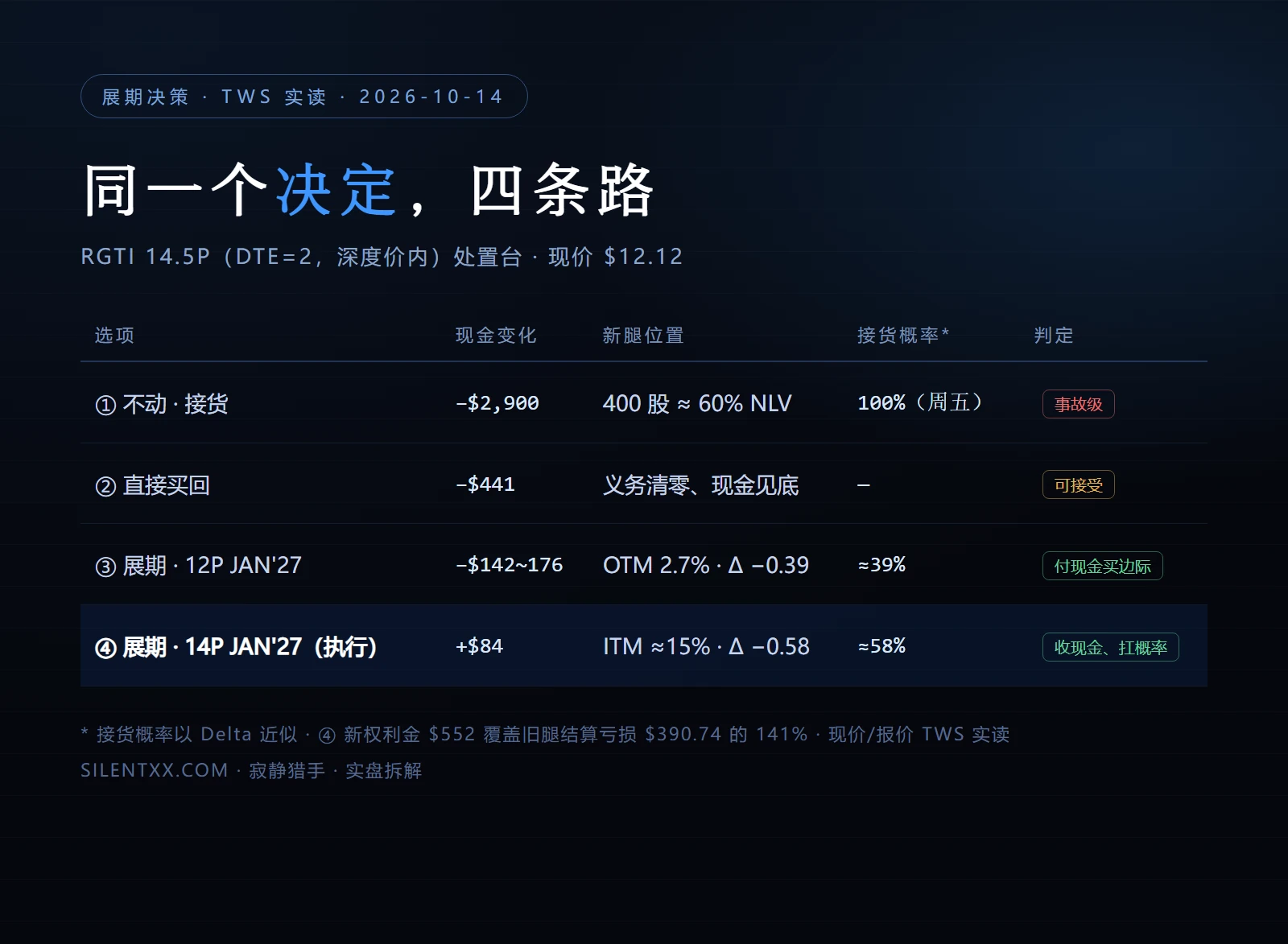
- Straight buy-back: −$441 to clear the bomb and zero out the obligation — but cash drops to about $580, still below the floor;
- Roll to 12P (Jan): pay $142–176 net, in exchange for a lower Δ (−0.39) and a 2.7% buffer — cash buys safety margin;
- Roll to 14P (Jan): receive $84 net, downgrade the strike (14.5 → 14.0) and add 91 days — odds buy cash flow.
The cash difference between ③ and ④ is about $230. I chose the one that pays, and wrote its cost out in full: the new leg is still ~15% in the money with Δ −0.58 — assignment remains the base case (roughly a 60% probability), not a tail scenario. This is not defusing a bomb; it’s swapping one: a two-day bomb for a ninety-three-day bomb that came with a small cash rebate.
4. Execution Record: One BAG Order, Buy Before Sell
- 10:03:22 ET, a single BAG order filled: net +$0.42/contract ($2.76 − $2.34), 2 contracts = +$84;
- Why the combo: both legs fill atomically — there is no naked window between “sold first” and “bought later,” and the price locks the moment the order is placed;
- Post-fill checks: cash $1,020.50 → $1,101.48; the position-change detector logged it automatically (14.5P gone, 14P JAN on the books).
(As I write this, the new leg quotes $2.72/$2.89 — essentially flat against the $2.76 sale. This roll is currently neither up nor down; what it bought is time.)
5. The Cost, and What Comes Next: Three Months Is Not “Set and Forget”
The cost first, in three lines: assignment odds around 60%, assignment cost $2,800, and margin down only one notch (76.8% → 75.3%, still above the 60% hard gate). So the position gets three management trigger lines:
- Leg price ≤ $1.40 (about 50% off the $2.76 sale) → evaluate buying it back and closing;
- RGTI reclaims $14+ → let time value decay on its own, don’t fiddle;
- Nodes: review before the 11/11 earnings; by 30 days before 1/15 expiry, a decision must be on the table — no improvising on expiry day.
And one line to my future self: if assigned, assignment day is reduction day — handled within two trading days, no averaging down, no adding, no waiting to break even.
6. On the Same Books: NOK’s 10-Lot Trade
One more action sits in the same week’s account: on 10/13 (ET afternoon) I bought NOK JUN 2027 10C ×10 @ $1.87. Its designation is a “trade lot” — a short-term catch that leaves on the bounce, booked separately from the 20-contract base position, with the exit timing in my own hands. It lowered the LEAP average from $2.563 to $2.334; and the process note goes on the ledger as usual: the add happened in a window where margin sat above the thaw line — writing the full record is the least “marketing account” thing about this system.
7. Hunter’s Review
Done right:
- Didn’t solve assignment with assignment — cross out the most expensive default outcome first; only then are the remaining options worth comparing;
- Clean execution — combo order, mid-price sale, books matching to the cent;
- Positive cash-flow direction — between “pay to roll” and “get paid to roll”, the ~$230 stayed in the pocket.
To remember:
- One day late cost about $114. The plan said hard deadline 10/13, limit $1.75–1.77 to ensure a fill — it went unexecuted. Over three days RGTI fell another ~5%, and the same buy-back went from ~$1.77 in the plan to $2.34 in the fill. Most of a roll’s bill is written by waiting.
- A roll is not a recovery. 141% coverage means “this roll was net-positive,” not “nothing was lost” — the −$390.74 old-leg settlement is in the books and stays there.
- Three months is three decisions. The trigger lines aren’t decoration; next time you read this, go check their current values first.
“Roll” sounds like giving it a little more time. On the ledger, it writes a different sentence: cash and time, spent to re-price risk.
This re-pricing came out at +$84 — small, but the direction is right: the account did not have to become something it doesn’t want to be, just because a contract reached its expiry.
Bomb disposal technicians shouldn’t fall in love with bombs. See you in three months.
Journal · part of the quantum-position management series with Two Legs on a Quantum Rally Day, Phased Stock Exit Day 1: RGTI’s 18C Rent Lease and QUBT/RGTI Twin Call Buy-Back.
Evidence: fills and settlement reads from TWS (get_fills: the 10/14 BAG legs at $2.34 / $2.76; reqPnL −$390.74; cash $1,020.50 → $1,101.48 cross-checked against before/after snapshots); account basis and ledger via the trading journal.