





Say Goodbye to the “Roller Coaster,” Switch to “Collecting Rent”
If you’re a long-term stock investor, your mood must depend on K-line colors:
- 🔴 Drop: Can’t eat, anxious.
- 🟢 Rise: Don’t dare sell, afraid of missing out, anxious.
- ➡️ Sideways: Wasting time, anxious.
Notice? You’re always anxious. Because your returns completely depend on “stock price difference”.
But in the Silent Options community, we don’t really care about today’s stock price movements. Because our goal isn’t “catching that 10x stock”, but “building a 12%-24% annualized cash flow system”.
Today, I’ll introduce you to the option seller’s ultimate weapon — “The Wheel Strategy”.
Step 1: Want to Buy Stock? First Collect a “Waiting Fee” (CSP)
Suppose you want to buy 100 shares of Apple (AAPL), current price $150. Normal people buy directly at $150.
What do smart people do? They think: “Too expensive, I only want to buy if it drops to $140.” So, they sell a Put (put option) with strike price $140.
Then something magical happens:
- The broker immediately gives you a premium (say $50). This money goes straight into your pocket.
- If next Friday the stock does not drop to $140: You keep the $50. You did not get the stock, but you got paid.
- If next Friday the stock drops below $140: You are assigned at $140 (effective cost about $139.5 after premium). But note: the stock is already below $140, so you are underwater at assignment — at $120, the unrealized loss is about $1,800, and the premium only offsets $50.
This is Cash Secured Put (CSP) — Buffett’s favorite “discounted stock buying method”.
Step 2: Holding Stock at a Loss? Then Collect “Rent” (CC)
Okay, now you have 100 shares of Apple. Normal people choose to “play dead,” praying it goes up.
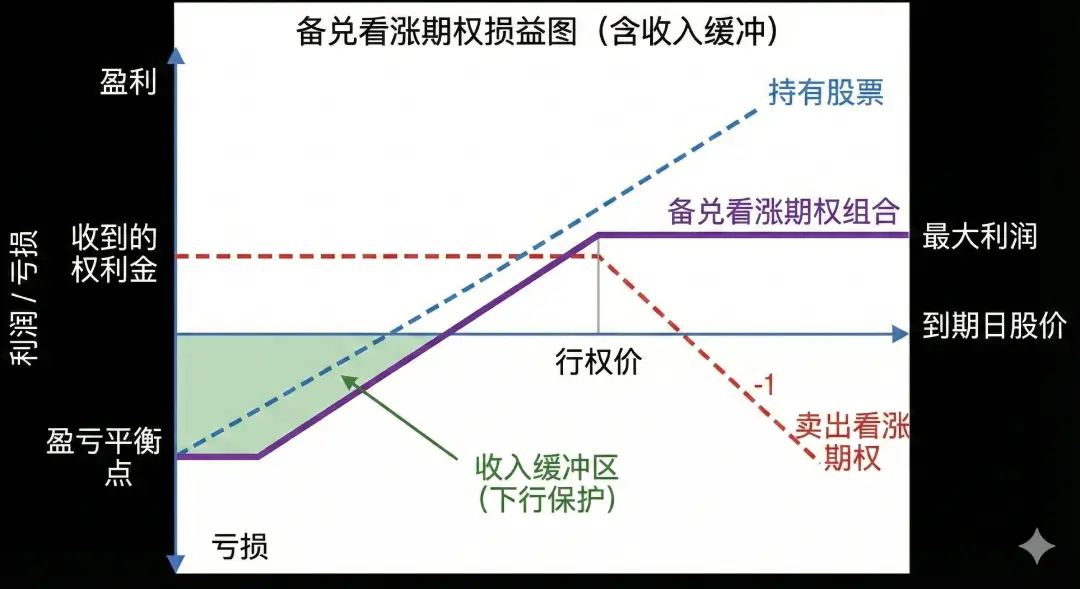
What do smart people do? They treat these 100 shares as a “house” and rent it out. They sell a Call (call option) with strike price $160.
Then:
- The broker immediately gives you another premium (say $40).
- If next Friday the stock does not reach $160: The stock stays with you, but you collected that $40 rent. You can sell another next week — the price will change.
- If it surges above $160: Your stock gets sold at $160. You earned the price appreciation plus the rent — but the move above $160 is not yours.
This is Covered Call (CC) — one of the most common income tools for retail investors.
Step 3: The Repeatable Loop
See it?
- No stock: Sell Put to collect money, until you get assigned the stock.
- Have stock: Sell Call to collect rent, until the stock gets sold.
- After selling? Back to step 1, continue selling Put.
This is called The Wheel (Wheel Strategy).
This is a repeatable loop. In this process you do not need to predict tomorrow’s move; you mechanically execute the cycle — but before every assignment, work out how far you can hold.
⚠️ The prerequisite is picking the right underlying. The Wheel strategy works best on quality stocks with a long-term upward trajectory. If you pick stocks with deteriorating fundamentals (e.g., the old GE, Intel), you’ll keep “catching falling knives” on the way down, and the premiums won’t come close to offsetting the share price losses. Stock selection is the most critical foundation of this system.
Next Step: Build Your System Hands-On
By now, from Awakening 01’s “win rate”, to 02’s “risk control”, to 03’s “cash flow”. You’ve mastered all the theoretical foundations to become a “house”.
But “knowing” and “doing” are separated by ten thousand details:
- “Which stock should I use for Wheel?”
- “What strike price is suitable? Delta 0.3 or 0.2?”
- “What if earnings report crashes?”
Don’t worry. In the upcoming [Beginner Combat Course], we’ll leave theory and enter the real battlefield. I’ll open my trading software and teach you step-by-step to place your first sell order in life.
📝 Silent’s Note (Key Points)
- Don’t Want to Buy High: Using CSP (Sell Put) you can get assigned at your psychological price, plus collect money.
- Don’t Want to Hold Forever: Using CC (Sell Call) you can collect rent on holdings, lowering position cost.
- Spin It Up: Connect CSP and CC, and you have a repeatable process.
Next up: the practical part — which tickers, which strikes, and how to handle earnings. Get the rules right before talking about returns.